Today, when the role of aesthetic factors in the person’s discovery of the world increases, elemental or empirical creation and use of color effects in non-material cultural life oftentimes does not correspond to the high demands of culture and to the social progress of society. Development of creative capacities of a person today is valid as a result of chromo-aesthetization of the environment and the personality’s inner world. The level of development of creative capacities of a person in polychromatic socio-cultural environment depends on the system of upbringing and education.
The Cranes Are Flying in English (dubbing) is one of the most emotionally intense films out of the Soviet canon. An art house favorite, it is also the only Soviet film to win the revered Palme d’Or at Cannes. The Second World War epic casts light on a young couple who are torn apart by history’s turbulent events. Rife with personal trauma and suffering, this superb drama will pull your heartstrings through the microcosm of a single love story. With stunning visuals, supreme cinematography and passionate performances, it is still considered to be one of the greatest romance films originating from Russia.
If you're looking for a typical war movie, this is not it, so a note to all the testosterone-pumped carnage-craving war buffs out there, don't bother. Although the film is about Russian characters in WWII, don't expect to see any Nazis, cannons, blood, gore, etc. It's not a film about people who cause a war or who fight a war. It's a film about ordinary people who war happens to and the choices they make in dealing with it.
Ivan's Childhood with English subtitles , sometimes released as My Name Is Ivan in the US, is a 1962 Soviet war drama film directed by Andrei Tarkovsky and co-written by Mikhail Papava and an uncredited Tarkovsky, based on Vladimir Bogomolov's 1957 short story Ivan.
Ivan's Childhood was Tarkovsky's first feature film. It won him critical acclaim and made him internationally known. It won the Golden Lion at the Venice Film Festival in 1962 and the Golden Gate Award at the San Francisco International Film Festival in 1962. The film was also selected as the Soviet entry for the Best Foreign Language Film at the 36th Academy Awards, but was not accepted as a nominee. Famous filmmakers such as Ingmar Bergman, Sergei Parajanov and Krzysztof Kieślowski praised the film and cited it as an influence on their work.
During World War II, 12-year old Ivan works as a spy on the eastern front. The small Ivan can cross the German lines unnoticed to collect information. Three Soviet officers try to take care of this boy-child.
Watch online Ivan's Childhood with english subtitles
Only Old Men Are Going to Battle[ В БОЙ ИДУТ ОДНИ СТАРИКИ ]
Only Old Men Are Going to Battle with English subtitles is an iconic 1973 Soviet war drama film produced in the Ukrainian SSR about World War II fighter pilots, written and directed by Leonid Bykov, who also played the lead role as the squadron commander.
Stunning WWII flying sequences as the Soviet Air Force battles the Luftwaffe. Veteran Russian pilots teach their new recruits about life, death & love. When the older men fly into battle, will the young pilots be ready to fight - and how many will return?
Watch online Only Old Men Are Going to Battle with english subtitles
Destiny of a Man (Fate of a Man) is a 1959 Soviet film adaptation of the novel by Mikhail Sholokhov, and also the directorial debut of Sergei Bondarchuk. In the year of its release it won the Grand Prize at the 1st Moscow International Film Festival. Bondarchuk would win again for the first part of his colossal adaption of Tolstoy's War and Peace, titled Andrei Bolkonsky, six years later.
At first I thought this film would be the usual war film in total line with the politburo's view on The Great War. But after 15 minutes in the film, something changes. First we have a scene in which Sokolof (the main character played by director Bondarcuk) comes home drunk - something I have never seen in an older Soviet movie, than the war breaks out and after a slightly over the top scene in which Sokolof says goodbye to his family all hell breaks loose.
Ballad of a Soldier with English subtitles is a 1959 Soviet film directed by Grigori Chukhrai. The film was produced at Mosfilm and won several awards, including the BAFTA Award for Best Film from any Source and was nominated for the Academy Award for Writing Original Screenplay.
During World War II, 19 year old soldier Alyosha gets a medal as a reward for a heroic act at the front. Instead of this medal he asks for a few days leave to visit his mother and repair the roof of their home. On the train eastwards he meets Shura who is on her way to her aunt. In those few days traveling together they fall in love.
Watch online Ballad of a Soldier with english subtitles
Trial on the Road with English subtitles is a 1971 Soviet film set in World War II, directed by Aleksey German. It is also known as Checkpoint or Check up on the Road.
Trial on the Road was censored and taken out of circulation in the Soviet Union for 15 years after its release due to its controversial depiction of Soviet soldiers. The film is based on a story by the director's father, Yuri German. The screenplay was written by Eduard Volodarsky.
Film is set in the winter of 1942 during the Nazi occupation of Russia in WWII. Partisan guerrillas, headed by Ivan Lokotkov, are testing the POW Lazarev, who briefly collaborated with the Nazis for survival. Lazarev is not executed, but instead he is given a chance to prove his loyalty. He has to go back to the Nazi controlled railway station, where everyone knows him, and to hijack a train with food supplies. Lazarev proves himself a hero.
Watch online Trial on the Road with english subtitles
The Cuckoo with English subtitles is a 2002 Russian historical comedy drama film directed by Aleksandr Rogozhkin.
September of 1944, a few days before Finland went out of the Second World War. A chained to a rock Finnish sniper-kamikadze Veikko managed to set himself free. Ivan, a captain of the Soviet Army, arrested by the Front Secret Police 'Smersh', has a narrow escape. They are soldiers of the two enemy armies. A Lapp woman Anni gives a shelter to both of them at her farm. For Anni they are not enemies, but just men.
Come and See with English subtitles is a 1985 Soviet war drama film directed by Elem Klimov about, and occurring during, the Nazi German occupation of the Belorussian SSR. The film was selected as the Soviet entry for the Best Foreign Language Film at the 58th Academy Awards, but was not accepted as a nominee.
During WWII, a Belarusian boy is thrust into the atrocities of war, fighting with a hopelessly unequipped Soviet resistance movement against ruthless German forces. Witnessing scenes of abject terror and surviving horrifying situations, he loses his innocence and then his mind.
Panfilov's 28 Men with English subtitles is a 2016 historical film by Kim Druzhinin and Andrey Shalopa about the act of bravery of a group of Soviet soldiers from the Panfilov's Twenty-Eight Guardsmen in the defense of based on 8th Guards Rifle Division operations during the 1941 Battle of Moscow is set in the Eastern Front of World War II.
USSR, Late November, 1941. Based on the account by reporter Vasiliy Koroteev that appeared in the Red Army's newspaper, Krasnaya Zvezda, shortly after the battle, this is the story of Panifilov's Twenty-Eight, a group of twenty-eight soldiers of the Red Army's 316th Rifle Division, under the command of General Ivan Panfilov, that stopped the advance on Moscow of a column of fifty-four Nazi tanks of the 11th Panzer Division for several days. Though armed only with standard issue Mosin-Nagant infantry rifles and DP and PM-M1910 machine guns, all useless against tanks, and with wholly inadequate RPG-40 anti-tank grenades and PTRD-41 anti-tank rifles, they fought tirelessly and defiantly, with uncommon bravery and unwavering dedication, to protect Moscow and their Motherland.
Watch online Panfilov's 28 Men with english subtitles
St. Petersburg is one of the most mysterious cities in the world. It attracts and repels at the same time. It is either loved or hated, but the city on the Neva does not leave anyone indifferent. The northern capital of Russia is beautiful and majestic, when the sun is shining, but mysterious and terrible in the light of the moon. There is an opinion that the highest concentration of spiritual energy on unsteady soil is found here. Surrealistic atmosphere of St. Petersburg is best felt by creative people, who have increased sensitivity. That's why they always come here from all over the world. Having arrived here, they are often lost in their emotions and feelings. The Northern Palmyra circles them in a whirlwind of waltz, in a whirlwind of riddles and secrets, in a whirlwind of contradictions.
Waltz, waltz, waltz…
It can be said with certainty that St. Petersburg crowned Johann Strauss. The waltz king created more than 500 waltzes. And in each of them there is enjoyment of life, of every breath we take on this earth. Any waltz by Johann Strauss is usually five waltzes, five suites, each one with its own meaning and mood, like a full life.
One, two, three. One, two, three…
Waltz is performed to music with three beats in tact. Each tact begins with a percussion score, and ends with a less dedicated one, which creates problems for the beginners, and pleasure for the more experienced dancers.
Adam Mickiewicz (Poland)
Александр Михайлович Герасимов
А. С. Пушкин и Адам Мицкевич
Kazanskaya (Bolshaya Meschanskaya) Street, 39.
This address is where the Polish poet lived in 1828-1829. But the first time Adam Mickiewicz visited us was in 1824. It was then that he met Pushkin, Ryleyev and Bestuzhev. Mickiewicz did not like Petersburg.
However, it was in the Northern Capital in 1828 that the poem "Konrad Wallenrod" was published. He dedicated this poem to the Emperor Nicholas I. The protagonist of the poem is a single fighter in the camp of the enemy who is trying to save his people. Mickiewicz also has such poems as "Monument to Peter the Great", "Petersburg", "To my Moskal friends" ... There was only one place in the Northern Palmyra, where Mickiewicz strove with all his heart. It was the home of the composer and pianist Maria Shimanovskaya (today it is the Theater of Musical Comedy on Italianskaya, 15). He called her "the queen of sounds".
Maria was 9 years older than Adam, but they were born on the same day. In 1831, Maria Shimanovskaya died of cholera. Adam Mickiewicz maintained relations with her daughter Celina, whom he married in Paris in 1834.
The couple died in 1855.
One, two, three. One, two, three…
Change steps, hesitations, hovers, passing changes, natural reverse turns, Fleckerls, contracheck and 180 beats per minute - this is what makes up a true Vienna Waltz, which is not from Austria. This is how we call it nowadays, because in the beginning of the XIX century this waltz experienced a peak of popularity in Vienna ... to the music of the king of waltz.
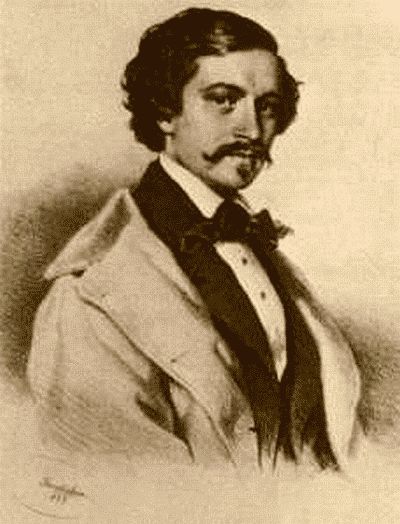
Johann Strauss (Austria)
Kurzal (Pavlovsky railway station)
“One can only live in Russia!”
Johann Strauss
Vauxhall in Pavlovsk. Lithograph by K.K.Schultz from the original by I.I.Meyer. 1845
This was someone who truly loved Russia and Petersburg, even though on his first trip to Russia (modern day Poland) he ended up in prison, along with his orchestra. The Empress Alexandra Fyodorovna helped the musicians, who were mistaken for rebels. Strauss thanked her with a magnificent concert. A few years later, in 1855, he received an invitation to St. Petersburg. It was not just an invitation, but a long-term contract for 10 years with a fee of 22 thousand rubles per season, which was a huge sum of money. How could he possibly have declined? At the Pavlovsky railway station near St. Petersburg, Johann Strauss conducted the orchestra, and composed music in his spare time. The public fell in love with him wholeheartedly and began to call him "Ivan Strauss" in the Russian manner.
In 1857 in St. Petersburg in the salon of Count Leo Sollogub Johann Strauss met Olga Smirnitskaya, who is considered one of the first Russian female composers. Strauss fell in love with her in earnest. Even his show of affection was quite extraordinary, in the autumn of 1858 he included her polka-mazurka in the program of his own concert. Their romance was not destined to grow into a marriage. There were quite a few obstacles: Olga's parents, his own mother… And Olga herself sometimes acted like Dostoevsky's Nastasya Filippovna. On the other hand, there was a time when they wanted to elope and marry secretly. It was his first love to whom Strauss dedicated the polka "Olga" and the waltz "Road adventure". And the sad waltz "Farewell to St. Petersburg" is simply overwhelmed with romantic longing.
"Is it possible to find words to describe to you my feelings when I read your lines that inspired me! I assure you that this was the happiest moment in my life ... So take my heart so that it can prove to you how much it loves you, so that it would give up without a trace that, which was sent unto it by by the Creator Himself!" - this is an excerpt of a letter from Strauss to Olga. (Olga Smirnitskaya’s letters to Johann Strauss were not found)
In 1862, as soon as Johann Strauss learned of Olga’s marriage to a Russian officer, he immediately married the opera singer Jetty Chalupetzky, who looked much like Olga.
One, two, three. One, two, three…
There is a peasant French dance in Provence, which is quite similar to waltz. Known since 1599, it was performed to the folk music, “Volta”, which means turn in Italian. The basis of such dance is a continuous rotation.
Honoré de Balzac (France)
Millionnaya, 24
Садовников В. С. Вид Дворцовой площади с Миллионной улицы. 1830-е
This was the address of Honoré de Balzac and the recently widowed Ewelina Hańska, for just 3 months in 1843. Their romance began 11 years earlier, with a letter from Odessa. Ewelina sent a letter to her favorite author, having signed it “Stranger”. This is how he called her till the end of his days, as well as, “Adored lady”, “Proud queen”, “Northern star”, “my Atala” (like a character from Chateaubriand’s novella)...
“Your soul has lived for centuries, my dear sir, and meanwhile I was assured that you are still young, and I wanted to get to know you ... When I read your works, my heart trembled; You show the true virtue of a woman, love for a woman is a gift from heaven, a divine emanation; I admire you for the wonderful subtlety of the soul, this is exactly what allowed you to understand the soul of a woman” This is an excerpt from Ewelina Hańska’s letter.
Their meeting in Petersburg, like their other meetings, was short, but passionate. Together they loved to walk along the Dvortsovaya Embankment and along the Winter Grove. The northern capital of Russia bewitched both.
“The gloomy Berlin is incomparable with the magnificent Petersburg. First of all, it is possible to cut a dozen such small towns as the Brandenburg capital from the territory of the great city of the vastest of European empires, after which it would still have enough built-up space to cover twenty small Berlins carved from its endless expanses. But at a first glance Berlin seems more populated, for I saw several passers-by on the streets, which you often will not see in Petersburg! The spaces are built up with the expectation of highlighting the beauty of the city, and it is to this trick, probably, that Berlin owes an impression of a larger population than St. Petersburg.” - Balzak wrote about Petersburg. The city on the Neva never became a hero of his novel. Although he was fascinated by the love story of Peter I and the regimental laundress Martha.
But the love story of Honore de Balzac and Ewelina Hańska was no less fascinating. Only seven years after the trip to Petersburg would they get engaged.
“Only you must learn from me about the happy ending of the great and beautiful drama of the heart, which lasted for sixteen years. Three days ago I married the only woman I ever loved, the one I love now even more than before, and will love until my death.” This is a quote from Balzac’s letter to a friend.
Several months later Honore de Balzac died. Ewelina lived without him for another 32 years and was buried next to him.
One, two, three. One, two, three…
“Waltzen” is the name of the prototype of the modern-day waltz. It first appeared in Germany in 1754. Gradually "Waltzen" and "Volta" merged together and began to resemble the rhythm and character of the Viennese waltz, as we know it today. Paris in 1770 for the first time saw a performance of a dance, similar to the modern waltz.
Alexandre Dumas, père (France)
Sverdlovskaya Embankment, 40 (country house of Kushelev-Bezborodko)
The Marquis Alexandre Dumas Davy de la Pailleterie stayed in this house in the summer of 1858. For almost thirty years he dreamed of visiting Russia. After all, his works were staged successfully in St. Petersburg theaters since 1829. “Henry III and His Courts”, “Antony”, “Richard Darlington”, “Teresa”, “Kean, ou Désordre et génie” - these performances always sold out. It is a known fact that Dumas was not deprived of vanity and collected various regalia. In 1839, he sent the Russian Emperor Nicholas I his manuscript "The Alchemist" in a smart cover, signed as "Alexandre Dumas, the Chevalier of the Belgian Order of the Lion, the Order of the Legion of Honor and the Order of Isabella the Catholic." He was hoping for the Order of St. Stanislaus of second or third degree, but received only a diamond ring with a monogram. So decided Nicholas I, who did not like romantic dramas. Dumas was offended and dedicated the "Alchemist" to his future wife, Ida Ferrier. Soon after in the journal “Revue de Paris” he began to publish the novel “Mémoires d’un maître d’armes, ou dix huits mois à Saint-Pétersbourg” … about the Decemberists (a propos, 18 years later he met the prototypes of his characters, Annenkov and Luisa). It is also interesting that the novel contains a description of St. Petersburg, which the writer had not visited by then.
“Directly in front of me was the Vasilievsky Island and the stock exchange, a fashionable building, which was built, I do not know why, between two rostral columns. Two of its semicircular stairs descend to the Neva. There are also all sorts of scientific institutions nearby - the University, the Academy of Sciences, the Academy of Arts and where the river makes a steep bend - the Mining Institute. On the other side the Vasilievsky Island is washed by the Little Nevka, which separates it from the Volny Island. Here, in the beautiful gardens, behind the gilded bars, for the three St. Petersburg summer months, blossom all sorts of rare plants brought from Africa and Italy. The luxurious dachas of St. Petersburg nobles are also located here. If you stand with your back to the fortress, and face against the current of the river, the panorama changes, still remaining grandiose. In fact, not far from the bridge where I stood, there are on one side of the Neva the Trinity Cathedral, and on the other - the Summer Garden. In addition, I noticed on my left a wooden house in which Peter lived during the construction of the fortress.”
Naturally, Nicholas I was outraged, and the novel was banned. Getting a Russia visa was out of the question. Dumas père’s interest in a trip to Russia came back after his son’s love affairs with two Russian noble women, the countess Lidia Nesselrode and the duchess Nadezhda Naryshkina (his future wife). Dumas was able to visit Russia only after Nicholas’s death. In Paris in 1858 he met the Kushelev-Bezborodko family, and along with them he went on a trip to several Russian cities. Petersburg was the first Russian city he visited. “He was impressed by the droshky, the coachman in long caftans, their caps resembling a goose liver paste, and the diamond-shaped copper plates that hung on their backs.”
Дюма дарит Санкт-Петербургу «карманное издание избранных своих сочинений». (Карикатура из журнала «Живописная русская библиотека». 1858 г.)
Everyone knows Dumas was a gourmet. There was even a joke that immediately after Dumas’ arrival in Petersburg, a queue of admirers lined up for him, they were cooks, not readers or writers.
It is unknown whether Dumas knew about this joke. But the fact was that he did not like the sterlet ukha. Here is what he wrote about it: “Out of concern that the Emperor will not allow me to return to St. Petersburg, I will say this. The greatest, or, more precisely, the only virtue of the sterlet ukha is, in my opinion, in the following. In Petersburg in the summer it costs 50 or 60 franks, but in the winter, 350 or 400. We don’t share the Russians’ fantastic love for the sterlet. This fish is insipid and fat, and the cooks do not try to emphasize its pleasant taste. One needs to come up with a sauce for this fish, and I dare to suggest that only the French can do it.” Dumas dined in restaurant “Samson” in Peterhof, which exists to this day.
Dumas ordered shchi and a steak. The French guest did not like dinner. He later called shchi a cabbage pottage with overcooked meat. Together with him was the writer Grigorovich, whose ability to cuss with waiters with affectionate ease struck Dumas. But the French gourmet should have liked something from the Russian cuisine? Jam! Jam made of roses, pumpkins, radishes, nuts. And here is what the writer Avdotya Panayeva, the civil wife of Nikolay Nekrasov, wrote about Dumas’ stay in St Petersburg: “Dumas was a nightmare for me during his stay in St. Petersburg, because he often visited us, assuring us that he was resting at our dacha. One time I deliberately made such dinner for Dumas that I was completely convinced we would be rid of his visits for at least a week. I fed him shchi, a pie with porridge and fish, a pig with horseradish, ducks, freshly salted cucumbers, fried mushrooms and a sweet layered pie with jam and begged to eat more. Dumas delighted me, saying after dinner that he had a strong thirst, and drank a lot of seltzer water with cognac. But I hoped in vain: in three days Dumas appeared as if nothing had happened, and only the poor secretary paid for his Russian dinner instead. Dumas ate two plates of botvinya with freshly salted fish. I think that Dumas's stomach could have digested even amanita mushrooms!”
The information is contradictory. But, one way or another, North Palmira made a pleasant impression on Dumas. Moreover, a few years after his trip to Russia, he published the "Great Culinary Dictionary", where there is botvinya, kulebyaka and Russian charlotte with chocolate (сharlotte russe au chocolat). Botvinya and kulebyaka are understandable, but why charlotte with chocolate? Perhaps some of the hospitable Russians treated the French guest to this delicacy.
One, two, three. One, two, three…
“This dance is for girls of easy behavior!" - this opinion of waltz was held by many Englishmen at the beginning of the XIX century, while calling it "German waltz". And Lord Byron wrote about the waltz: "A healthy gentleman, like a hussar, swings with a lady as if on a swing, while they spin like two May beetles, planted on a single awl." But the waltz continued to conquer England. A few years later, new forms of waltz appeared in the English style: waltz-boston and a slow waltz.
H. G. Wells (England)
Kronverk Avenue, 23
This is the address of Maxim Gorky's apartment, where the English science fiction writer stayed in 1920. But on his first visit in 1914 he lived ... However, that time he arrived incognito. And the ubiquitous journalists were eager to find out exactly where H. G. Wells was staying. Employees of the British Embassy told reporters that the famous science fictionist was staying with P. P. Rodzianko. The journalists, without losing time, rushed to Rodzianko's house. The English guest was very kind to reporters and talked a lot about ... hunting. He did not say a word about his literary activities. The next day several newspapers (many simply reprinted the material from the "Birzhevye Vedomosti") ran an article titled "Writer Wells in Petersburg".
“The purpose of the arrival of the famous English writer, is the hunt for a bear, which Rodzianko will offer him tomorrow in his estate in the Vitebsk province. As a writer-fictionalist, as a depictor of the power of knowledge and the forces of nature defeated by man, as a social dreamer, Herbert Wells is well known, therefore we will not expand on this side of his activity. But in addition to his literary endeavors, the English writer enjoys a well-deserved reputation as a traveler and a fearless hunter. ... Herbert George Wells, with the purpose of hunting, traveled all of Africa far and wide, North America, Australia, visited New Zealand and finally made a trip from Shanghai to Omsk through the Gobi Desert… I see Wells as an extremely modest man. This is why I think he avoided talking about his works, despite the fact that they made him world famous.“
Soon it became clear that the journalists were not interviewing H. G. Wells. Rather, they interviewed the famous hunter Whines. The real fictionalist, meantime, was staying at the Hotel “Astoria”, and knew nothing of the whole story.
It would have been strange if the writer-prophesier had not visited the mysterious Petersburg. After all, 80% of the predictions in his books had already been fulfilled. "Asia is coming to Europe - with a new idea ... When you see this, you understand Dostoevsky better. You begin to understand this Holy Russia, and it seems like a kind of epileptic genius among peoples - like his Idiot ... "
Northern Palmyra can be different. Herbert Wells became convinced of this personally, when, in the autumn of 1920, he came here for the second time at the invitation of the new Soviet government. And this was already a completely different Petrograd. From an elegant-luxurious and hospitable city, it turned into a working suburb. Herbert Wells refused to stay in the mansion of the Third International. For two weeks he stayed with Maxim Gorky.
The English fiction writer stood in breadlines, ate in communal cafeterias, went to a public bath, where he feared that his clothes would be stolen. Even his imagination could not have drawn the terrible reality that he saw around. He visited schools, working universities, the Academy of Sciences, the House of Scientists. Herbert Wells also did not forget to visit the Hermitage and to listen to Chaliapin in the Mikhailovsky Theater. Wells even tried to understand his interlocutors in tone, gesture, expression, which was noticed by many. One evening at Gorky’s home, the actor Mokhov played a trick on the writer by making a toast in Russian, but with English accent. After that, Herbert Wells whispered to his neighbor: "He certainly speaks English, but what kind of dialect is this? I hear it for the first time."
The science fiction writer understood all about Northern Palmyra, which was fading away at the time. Returning to England, he wrote in his book "Russia in the Shadows":
“Nowhere in Russia is this catastrophe visible with such ruthless clarity as in Petrograd, which was an artificial creation of Peter the Great. His bronze statue still rises in a small square near the Admiralty, in the midst of a city fading away. The palaces of Petrograd are silent and empty or are ridiculously blocked by plywood and filled up with tables and typewriters of institutions of the new regime, which spends all of its resources on a tense struggle against hunger and interventionists. In Petrograd there were many shops in which there was a lively trade. In 1914, I walked with pleasure through its streets, buying various trifles and watching the crowds. All these shops are closed. In all of Petrograd there are, perhaps, only half a dozen shops left.“
One, two, three. One, two, three…
How many interesting and outstanding overseas cavaliers swirled in the whirlwind of the waltz of the Northern Palmyra in the course of history of its existence? It is impossible even to list. The city crowned and overthrew. For all, it was different, but always attractive.